
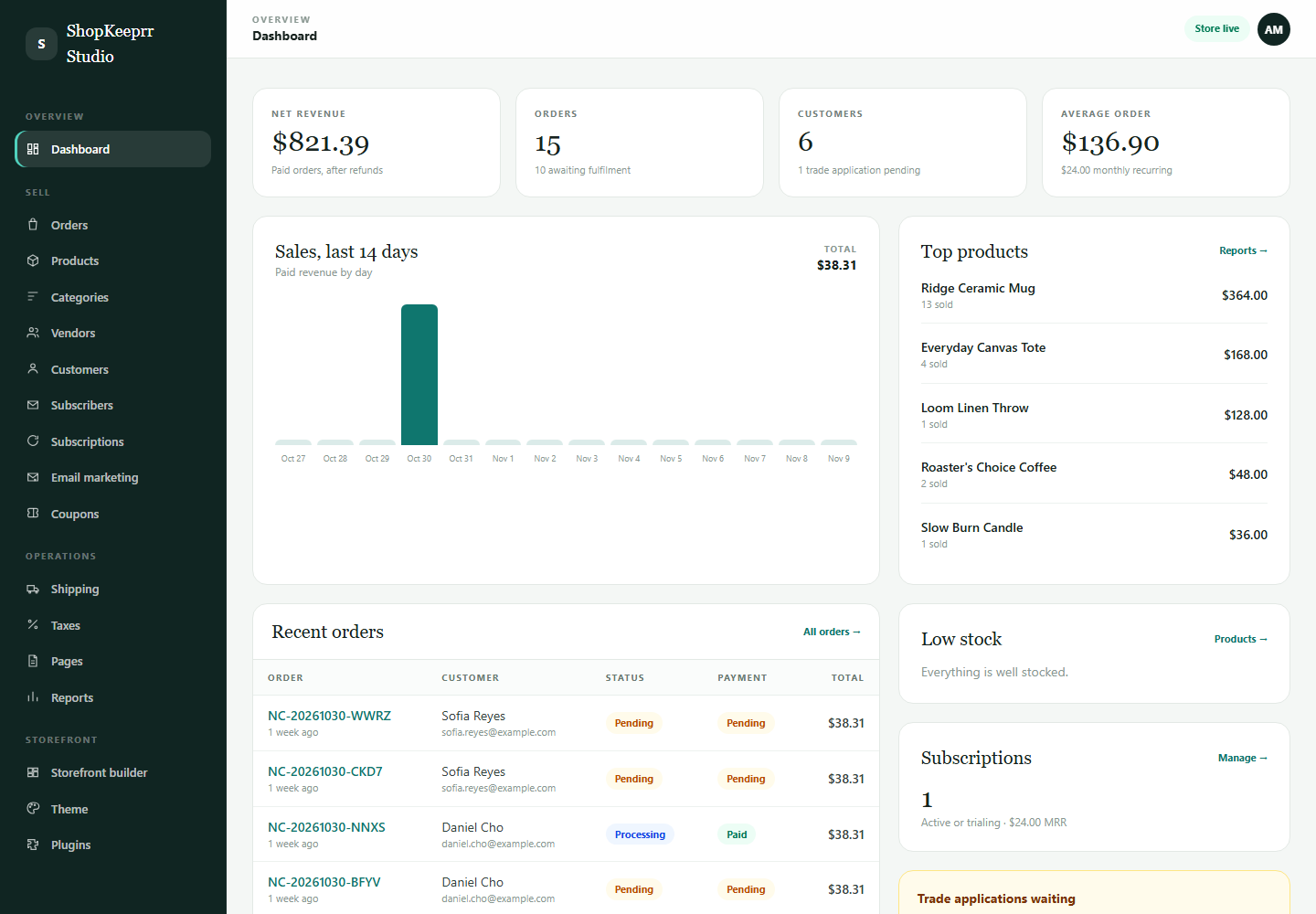
Short answer: Shopify is the lower-friction choice if you want a hosted store, integrated payments and a mature support ecosystem. ShopKeeprr is the stronger fit if you want to own the installation, avoid a platform subscription and use one self-hosted application for retail, B2B, subscriptions or a marketplace.
They are not the same kind of product. Shopify hosts the store; ShopKeeprr is software you install. That single difference drives the cost, control, maintenance and exit story. Neither model is automatically cheaper or better — it depends on the team and the store.
Editorial note: ShopKeeprr is our product, so we have a commercial interest in this subject. Competitor facts are taken from public documentation and linked where practical. Pricing and plan details can change; check the provider before you buy.
What you pay: Shopify vs ShopKeeprr
Shopify publishes a monthly subscription and charges payment processing rates on top. ShopKeeprr gives away its core application; you pay for hosting, your domain, payment processing and any optional extensions you choose. Those are very different bills, and they are not directly comparable line for line.
| Plan | Monthly | Yearly billing | Card rate | Third-party gateway fee |
|---|---|---|---|---|
| Shopify Basic | $39/mo | $29/mo | 2.9% + 30¢ | 2% |
| Shopify Grow | $105/mo | $79/mo | 2.7% + 30¢ | 1% |
| Shopify Advanced | $399/mo | $299/mo | 2.5% + 30¢ | 0.6% |
| Shopify Plus | From $2,300/mo | Custom | 2.25% + 30¢ | 0.2% |
| ShopKeeprr core | $0 license | $0 license | Your payment provider's rate | No platform transaction fee |
Shopify's third-party gateway fee applies when you do not use Shopify Payments. Card rates vary by country, plan and payment method. ShopKeeprr does not process payments itself; Stripe, PayPal and similar providers charge their own rates.
Why ShopKeeprr is not “free to run”
The core download is free. The server is not. A realistic ShopKeeprr budget includes hosting (shared, VPS or managed Laravel hosting), a domain, TLS, backups, payment processing, email delivery and the time or money spent on maintenance. Optional themes and modules can add costs too.
That does not make the comparison meaningless. It means you should compare total cost of ownership, not the sticker price of the software. Shopify bundles infrastructure, upgrades and support into its subscription. ShopKeeprr leaves those choices — and those bills — with you.
A simple worked example
Imagine a store doing $30,000 in annual card volume across 600 orders. On Shopify Basic billed yearly, the platform fee is about $348. At a representative 2.9% + 30¢ card rate, processing is about $1,050. That is roughly $1,398 before apps, theme purchases, domain or taxes.
The same store on ShopKeeprr pays $0 for the core license and roughly the same processing fee. Add hosting — perhaps $10 to $100 per month depending on the host and traffic — plus your time for updates and backups. At the low end, the cash saving is real. At the high end, or if you need paid help, it narrows quickly. The honest answer is: it depends on your hosting and how you value maintenance time.
Pricing source: Shopify pricing, checked 14 November 2026. The example is illustrative, not a quote or a guarantee of savings.
What you get out of the box
Price is only half the comparison. The more useful question is which product already contains the store you are trying to build. Here is the practical difference, feature by feature, without pretending the two platforms are interchangeable.
| Capability | Shopify | ShopKeeprr |
|---|---|---|
| Hosting | Included in the subscription | You provide the server or managed host |
| Storefront | Themes and theme editor; large theme ecosystem | Four complete themes and a visual storefront builder |
| Admin | Orders, products, customers, analytics, payments | Orders, products, customers, reports, payments, refunds |
| B2B wholesale | B2B tools available on Shopify plans; catalog limits vary by plan | B2B wholesale mode included in the core |
| Multi-vendor marketplace | Not a native marketplace; apps or custom development | Multi-vendor mode with seller onboarding, commissions and split payouts |
| Subscriptions | Subscription tools and apps, depending on plan and setup | Subscription mode included in the core |
| Extensions | Shopify App Store and theme ecosystem | ShopKeeprr Store modules, themes and components; module API |
| Updates | Shopify manages platform updates | Signed updates with backup and rollback; you run them |
| Infrastructure and security | Managed by Shopify within its platform scope | Your host and your team handle the server, PHP, database, TLS and patches |
| Data and code | Hosted account; export tools and APIs | Your database and installation; you control backups and access |
| Support | Shopify support and a large partner ecosystem | Documentation and community; no included SLA |
“Included” means the capability exists in the core product. It does not mean every configuration, payment method or country is covered, or that setup is automatic.
Where Shopify wins
- You do not want to run a server or manage updates.
- You value a mature app, theme and support ecosystem.
- You need a hosted checkout, integrated payments and predictable operations.
- You want to be selling today, not configuring a stack.
Where ShopKeeprr wins
- You want the store and its data on infrastructure you control.
- You want retail, B2B, subscriptions and marketplace modes in one application.
- You want no platform subscription or platform transaction fee.
- You are comfortable with PHP/Laravel hosting and routine maintenance.
Who handles hosting, security and maintenance?
This is the part that decides self-hosting for most teams. Shopify runs the platform. You still run your store: products, content, apps, taxes, discounts and customer service. But you are not responsible for the servers, the PHP runtime or the platform release cycle.
With ShopKeeprr, the responsibility split changes. You — or the host you pay — own the operating system, web server, PHP 8.3+, database, TLS certificate, queue worker, cron jobs and backups. ShopKeeprr's signed updater can back up the application and database before applying an application update, and it can roll back. It does not patch your server, tune MySQL or recover a deleted VPS snapshot for you.
A minimal self-hosting routine
- Keep PHP, the database and the web server on supported versions.
- Run application updates after taking a backup, ideally on staging first.
- Test the backup restore path, not just the backup creation.
- Monitor disk space, error logs, queue health and certificate expiry.
- Use HTTPS everywhere and keep payment webhooks verified.
- Limit admin access, use strong passwords and keep extensions current.
If nobody on your team wants to own the server, a hosted platform is usually the better decision — even if the subscription looks expensive. Self-hosting is not a discount for every business; it is an operating model.
B2B and multi-vendor: the biggest product difference
Shopify is excellent at single-brand retail and has expanded its B2B tools. ShopKeeprr was designed around four selling models from the start, including wholesale and multi-vendor. That does not make one universally better; it changes how much assembly each platform needs for a particular business.
B2B wholesale
ShopKeeprr's B2B mode includes trade applications, tier pricing and minimum quantities in the core. Shopify's B2B tools include company profiles, catalogs and volume pricing, with availability and catalog limits that depend on plan. Shopify's public plan comparison currently lists three B2B catalogs on Basic, Grow and Advanced; confirm the current limits before choosing a plan. For a small wholesale catalog, either can work. For complex price lists, quotes, customer-specific catalogs and net terms, model the workflow carefully on both platforms.
Multi-vendor marketplaces
Shopify is not a native multi-vendor marketplace. Sellers, commissions and split payouts generally require marketplace apps or custom development. ShopKeeprr includes a multi-vendor mode with seller onboarding, commissions and split payouts, plus a seller portal. If a marketplace is the business — not an add-on — ShopKeeprr starts closer to the destination, though you still own marketplace operations, seller vetting, tax and dispute handling.
Read the detailed guides: free multi-vendor marketplace software and B2B ecommerce software for small businesses.
Switching in either direction
There is no magic migration button between a hosted platform and a self-hosted application. Both directions are possible, but they require planning. Product data is usually the easy part; payment tokens, subscriptions, historical orders, apps, SEO URLs and customer expectations are where migrations get expensive.
Shopify to ShopKeeprr
- Export products, variants, customers and orders; map fields and tax data.
- Rebuild collections, theme content, discounts and email flows.
- Connect your payment provider and test a full purchase, refund and webhook.
- Keep the old store live while you verify the new one.
- Redirect old product and collection URLs; preserve title tags and descriptions.
ShopKeeprr to Shopify
Export your catalog, customers and orders from the database, then rebuild the storefront and checkout inside Shopify. Subscription and marketplace data need extra care. Whichever direction you choose, run a test migration with real sample orders and keep a rollback window.
Before committing, ask: can I export my products, customers, orders and content in a usable format? Who holds the payment tokens? What happens to customer history if I leave? A platform that makes export difficult is a platform that owns your leverage.
A practical decision guide
Choose Shopify if you want a managed store, integrated payments and a mature ecosystem, and you would rather pay a subscription than operate infrastructure. It is particularly compelling for a small team that needs to launch quickly and does not have Laravel hosting experience.
Choose ShopKeeprr if you want a free, self-hosted core; you need retail, B2B, subscriptions or multi-vendor in one application; and you are willing to own the server, updates and backups. It is particularly compelling for teams that already run PHP/Laravel infrastructure or want to keep customer and order data on their own systems.
Choose neither if the answer depends on a capability neither product has out of the box. A marketplace with complex escrow, a global enterprise catalog or a highly regulated checkout may need different software or custom development. The right answer is the platform whose missing pieces you can actually operate.
Questions to settle before you buy or install
- Who is on call when the checkout fails on a Saturday?
- Do you need B2B catalogs, quotes, minimum quantities or net terms?
- Are third-party sellers part of the business, or a future idea?
- What is the real annual cost of hosting and maintenance versus the subscription?
- How will you migrate products, customers, orders and URLs if you leave?
- Which payment providers work in your country, and who owns the merchant relationship?
Frequently asked questions
Is ShopKeeprr free?
The ShopKeeprr core is free to download, install, run and modify for your own store. Hosting, domains, payment processing, optional extensions and your maintenance time are separate costs. The license is proprietary, not open source.
Is ShopKeeprr cheaper than Shopify?
It can be, especially on the software line, because there is no platform subscription. But hosting, maintenance time and optional modules can close the gap. Compare total annual cost, including payment fees and the value of your time, rather than the license price alone.
Is ShopKeeprr open source?
No. ShopKeeprr is free to download and run, and you can modify it for your own use, but the core is proprietary and cannot be resold or redistributed. Shopify is a hosted proprietary service, so neither product is an open-source platform.
Does ShopKeeprr include Shopify Payments?
No. ShopKeeprr does not provide Shopify Payments. You connect your own payment provider, such as Stripe or PayPal, and pay that provider directly. Shopify Payments is part of Shopify’s hosted checkout.
Can I migrate from Shopify to ShopKeeprr?
Yes, with planning. Export products, customers and orders, rebuild content, reconnect payments, test orders and refunds, and redirect old URLs. It is a migration project, not a one-click import. The reverse direction has similar constraints.
Does Shopify support multi-vendor marketplaces?
Shopify is not a native multi-vendor marketplace. Marketplace sellers, commissions and split payouts generally require third-party apps or custom development. ShopKeeprr includes a multi-vendor mode in the core, but marketplace operations, seller vetting and tax still require real work.
Put it to work
Download the free ShopKeeprr core.
Install it on your own server, connect your database and start building. The core is free; hosting, payment processing and optional extensions are separate.